
Dua Before Eating: Arabic, Meaning & 5 Beautiful Tips
Dua Before Eating: authentic Arabic, transliteration, meaning and hadith source, with tips on when and how to recite it.
The Dua in Arabic
بِسْمِ اللَّهِ
───── ❖ ─────
Meaning of the Dua
In the name of Allah.
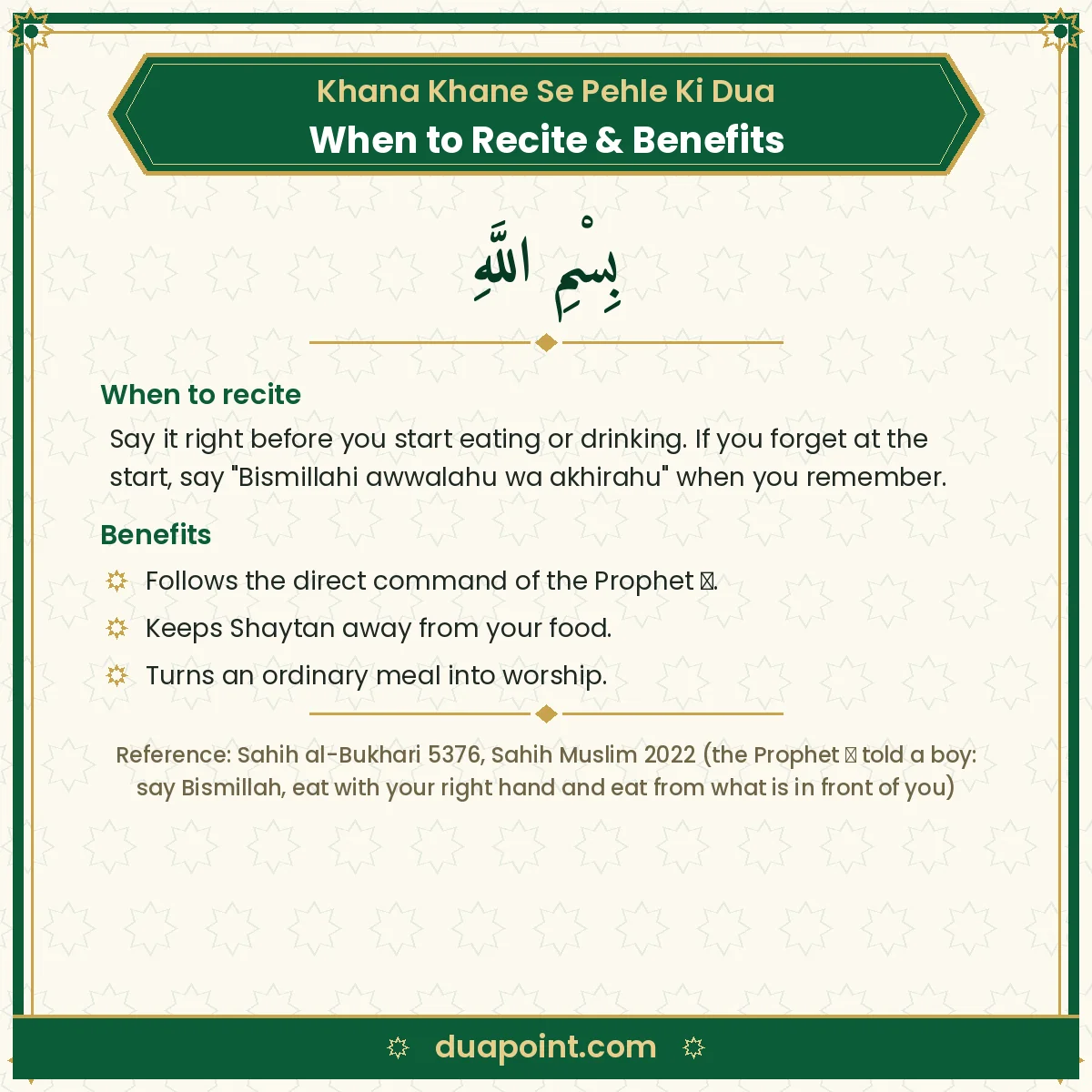
When to Recite
Say it at the moment it belongs to: before you begin, or straight after you finish.
Benefits of This Dua
Follows the authentic Sunnah of the Prophet ﷺ.
Brings the remembrance of Allah into daily life.
Strengthens trust and reliance on Allah.
Earns reward for a simple, consistent deed.
Source and Reference
Sunan Abi Dawud 3767, Jami’ at-Tirmidhi 1858 (If one of you eats, let him say: Bismillah); see also Sahih al-Bukhari 5376, Sahih Muslim 2022
Explanation
Saying the name of Allah before food turns an everyday meal into an act of worship and keeps Shaytan away from the food.
Every situation in a Muslim’s life has a remembrance, and the dua before eating is a beautiful example. Here is the authentic Arabic text with transliteration, translation and source, plus a simple explanation of its meaning.
Islam does not separate worship from ordinary life. Eating, dressing, leaving the house and even using the bathroom each have a short remembrance taught by the Prophet ﷺ. These adhkar are easy to memorise, take only seconds, and slowly turn an entire day into a chain of worship. Children who grow up hearing them learn that Allah is present in every small moment, not only in the masjid.
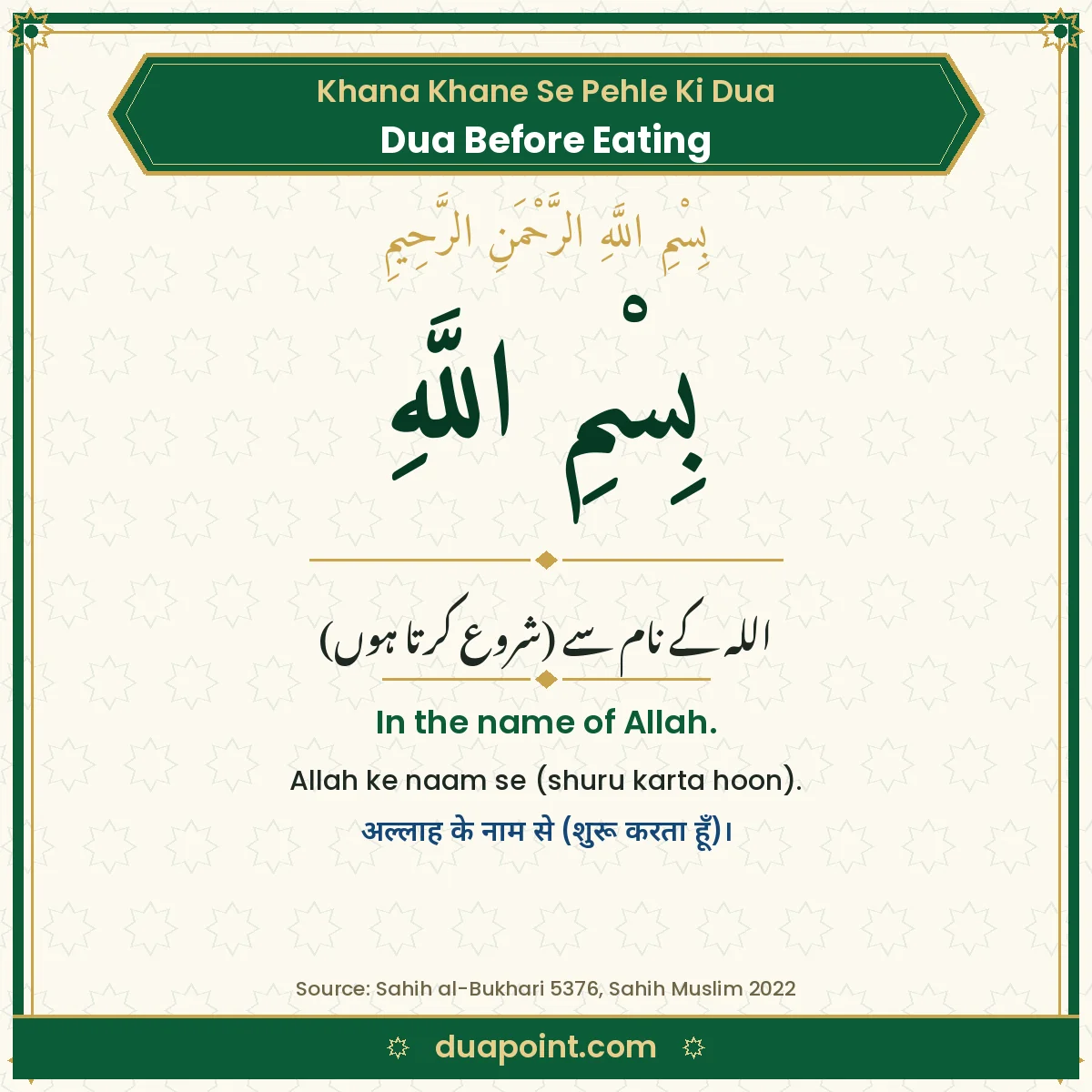
Dua Before Eating: Arabic, Transliteration and Meaning
Here is the authentic wording to use for the dua before eating. Saying the name of Allah before food turns an everyday meal into an act of worship and keeps Shaytan away from the food.
بِسْمِ اللَّهِ
Transliteration: Bismillah
Meaning: In the name of Allah.
English: In the name of Allah.
Urdu: اللہ کے نام سے (شروع کرتا ہوں)
Roman Urdu: Allah ke naam se (shuru karta hoon).
Hindi: अल्लाह के नाम से (शुरू करता हूँ)।
Source: Sunan Abi Dawud 3767, Jami’ at-Tirmidhi 1858 (If one of you eats, let him say: Bismillah); see also Sahih al-Bukhari 5376, Sahih Muslim 2022
5 Simple Steps to Recite the Dua Before Eating
The best way to benefit from the dua before eating is to make it part of your routine. Follow these simple steps:
- Learn the Arabic wording slowly, a phrase at a time, and check it with a teacher or a reliable book such as Hisn al-Muslim.
- Say it at the moment it belongs to: before you begin, or straight after you finish.
- Say it with presence of heart, thinking about the meaning rather than rushing the words.
- Teach it to your family by saying it aloud so that others pick it up naturally.
- If you forget, say it when you remember; Allah does not burden a soul beyond its capacity.
Meaning and Lessons of This Dua
Reflecting on the meaning is what turns words into worship. In the name of Allah. These words teach humility, trust in Allah and gratitude, three qualities that sit at the heart of every authentic dua.
Small, repeated acts are beloved to Allah. The Prophet ﷺ said the most beloved deeds to Allah are those done consistently, even if they are small (Sahih al-Bukhari 6464). A ten-second dua said every day for years becomes a mountain of reward and a habit of gratitude that shapes character.
Other Authentic Duas Related to Dua Before Eating
The Sunnah often gives more than one supplication for the same situation. Here are related duas you can add:
In the name of Allah at its beginning and at its end
If you forget to say Bismillah at the start of a meal, the Sunnah is to say this as soon as you remember.
بِسْمِ اللَّهِ أَوَّلَهُ وَآخِرَهُ
Transliteration: Bismillahi awwalahu wa akhirahu
Meaning: In the name of Allah at its beginning and at its end.
Source: Sunan Abi Dawud 3767, Jami’ at-Tirmidhi 1858
All praise is for Allah who fed me this and provided it for me without any might or power
This dua reminds us that every bite is a gift from Allah, not something we earned by our own strength alone.
الْحَمْدُ لِلَّهِ الَّذِي أَطْعَمَنِي هَذَا، وَرَزَقَنِيهِ، مِنْ غَيْرِ حَوْلٍ مِنِّي وَلاَ قُوَّةٍ
Transliteration: Alhamdu lillahil-ladhi at’amani hadha wa razaqanihi min ghayri hawlin minni wa la quwwah
Meaning: All praise is for Allah who fed me this and provided it for me without any might or power on my part.
Source: Sunan Abi Dawud 4023, Jami’ at-Tirmidhi 3458
Other Ways People Search for This Dua
This guide covers all of the following questions, since they refer to the same authentic dua and Sunnah:
- dua before drinking water
- dua before and after eating
- dua before and after meal
Each of them is answered by the same authentic wording and guidance given above.
O Allah, feed the one who fed me and give drink to the one who gave me drink
The Prophet ﷺ made this dua for the person who served him food and drink, teaching us to repay kindness with prayer.
اللَّهُمَّ أَطْعِمْ مَنْ أَطْعَمَنِي، وَاسْقِ مَنْ سَقَانِي
Transliteration: Allahumma at’im man at’amani, wasqi man saqani
Meaning: O Allah, feed the one who fed me and give drink to the one who gave me drink.
Source: Sahih Muslim 2055
Etiquette of Making Dua
To give your dua the best chance of acceptance, keep these authentic etiquettes in mind:
- Choose times of acceptance: the last third of the night, between adhan and iqamah, in sujud and on Friday.
- Call on Allah by His beautiful names that fit your request (Quran 7:180).
- Repeat your dua three times, as the Prophet ﷺ often did (Sahih Muslim 1794).
- Pray for others in their absence; an angel says ‘and for you the same’ (Sahih Muslim 2732).
- Combine dua with action and trust in Allah.
Many families keep the dua before eating written on a small card near the door or dining table so that children see it every day and learn it naturally.
Scholars remind us that the dua before eating is most beneficial when the heart is present, so pause for a moment before saying it and think about Whom you are addressing.
Common Mistakes to Avoid
- Using wording from social media posts or forwards that has no reference. Always look for a Quran or hadith source.
- Adding fixed numbers, times or rewards that are not in the hadith.
- Reading quickly without understanding; learning the meaning brings presence of heart.
- Treating the dua like a charm while neglecting the obligatory prayers.
- Giving up because the answer seems late; Allah answers in the way and time that is best.
Frequently Asked Questions about the Dua Before Eating
What is the authentic dua before eating?
The authentic wording is: Bismillah. It means: “In the name of Allah.” Source: Sahih al-Bukhari 5376, Sahih Muslim 2022 (the Prophet ﷺ told a boy: say Bismillah, eat with your right hand and eat from what is in front of you).
Do I have to say it in Arabic?
It is best to learn the Arabic wording because it is what the Prophet ﷺ taught. While you are learning, you may say the meaning in your own language, and you can always make personal dua in any language.
What if I forget to say it?
Say it as soon as you remember. Forgetfulness is forgiven, and the Sunnah for food specifically is to say Bismillahi awwalahu wa akhirahu when you remember.
Can children say this dua?
Yes. These daily adhkar are among the first things parents should teach their children, and saying them aloud at home is the easiest way to teach them.
If you are teaching the dua before eating to a new Muslim or a child, start with the meaning in your own language, then add the Arabic one phrase at a time.
Key Takeaways
- The authentic dua before eating is: Bismillah
- Its source is Sahih al-Bukhari 5376, Sahih Muslim 2022; you can check it on Sahih al-Bukhari 5376 on Sunnah.com.
- Say the dua before eating with understanding and presence of heart, not as a charm.
- Combine dua with effort, patience and the obligatory prayers.
Related Duas You May Find Helpful
Continue learning with these related guides from our Duas collection and Islamic Posts:
Conclusion
The dua before eating is a simple way to bring Allah into a moment of your day. Learn the Arabic, understand the meaning, and say it with a present heart. Share it with your family so that the reward continues, and remember that Allah loves to be asked: “Call upon Me; I will respond to you” (Quran 40:60).
Audio: Hisnul Muslim recitation by Hamad Al-Duraihim, IslamHouse.com
-

Dua for Waking Up: Arabic, Meaning & 5 Beautiful Tips
Dua for Waking Up: authentic Arabic text, transliteration, English…
-
Dua When Wearing Clothes: Arabic, Meaning & 5 Beautiful Tips
Dua When Wearing Clothes: authentic Arabic text, transliteration, English…
-
Dua When Looking in the Mirror: 5 Beautiful Sunnah Tips
Dua When Looking in the Mirror: authentic Arabic text,…
-

Dua When Leaving Home: Arabic, Meaning & 5 Beautiful Tips
Dua When Leaving Home: authentic Arabic, transliteration, meaning and…
-
Dua After Eating: Arabic, Meaning & 5 Beautiful Tips
Dua After Eating: authentic Arabic, transliteration, meaning and hadith…
أَلَا بِذِكْرِ اللَّهِ تَطْمَئِنُّ الْقُلُوبُ
“Verily, in the remembrance of Allah do hearts find rest.”
Surah Ar-Ra’d 13:28
-

Dua for Waking Up: Arabic, Meaning & 5 Beautiful Tips
Dua for Waking Up: authentic Arabic text, transliteration, English meaning and source…
-
Dua When Wearing Clothes: Arabic, Meaning & 5 Beautiful Tips
Dua When Wearing Clothes: authentic Arabic text, transliteration, English meaning and source…
-
Dua When Looking in the Mirror: 5 Beautiful Sunnah Tips
Dua When Looking in the Mirror: authentic Arabic text, transliteration, English meaning…
-
Dua When Leaving Home: Arabic, Meaning & 5 Beautiful Tips
Dua When Leaving Home: authentic Arabic, transliteration, meaning and hadith source, with…